DISPATCH · ONE SYSTEM
policy first.
approval at the boundary.
LumenFlow is one control plane for AI agent work: what’s allowed, where a human signs off, and what evidence is left behind — wherever the work actually runs.
One system, three layers
Wherever the agent and wherever the compute, the same policy, approval, and evidence pipeline sits in the middle.
AI / Agents
LumenFlow
Compute / Tools
Policy flows down · Evidence flows up
GovernPolicy before execution.
On supported governed paths, workspace scope and approval rules are checked before tool dispatch. Budget and quality gates apply where that workflow is configured.
ApproveHumans stay in control when risk crosses a boundary.
Routine work can continue under the workspace's trust preset. Tools marked for approval pause for a person, and consequential actions after connector or MCP reads require approval.
ExecuteRun through Sidekick, external agents, or connected compute.
Sidekick runs in the governed workspace. Supported local-runner and connected-runtime paths can use the same governance services when configured; coverage depends on the integration.
ProveAn independently inspectable evidence trail.
Supported governed action paths write hash-chained receipts. Exported evidence carries the fields captured by each path and can be checked for integrity with the matching records.
Every important decision
should be legible.
Teams need more than a successful run. They need to know why a change was allowed, what evidence was attached, and whether a person was asked to approve it along the way.
Agents you already run, governed the same way
Sidekick is LumenFlow’s own client. Everything below is someone else’s client, connected in as a governed runtime.
Claude Code
Connector targetAnthropic's coding agent can be connected through the reference bridge when configured; named-vendor enrollment is not a packaged adapter.
Codex
Connector targetOpenAI's coding agent is a connector target for the control-plane SDK and reference bridge; validate the exact governed actions in your setup.
Cursor
Connector targetThe Cursor IDE agent is a connector target. Governance and evidence depend on the configured integration and admitted action path.
MCP clients
Configured protocolConfigured MCP tools can run through LumenFlow's admission path, subject to workspace policy and server compatibility.
ChatGPT
OpenAI Apps pilot pathA client start-point for approved delivery review — a pilot path today, not the governance owner.
Product names are trademarks of their owners. They are used only to describe compatibility; no affiliation or endorsement is implied.
Each tour starts with a real product surface.
Pick a motion, then compare the same task with and without LumenFlow.
Your AI just booked a $400 flight.
Who approved that?
Sidekick handles everyday tasks — travel, expenses, scheduling. Without governance, you have no idea what it accessed or spent.
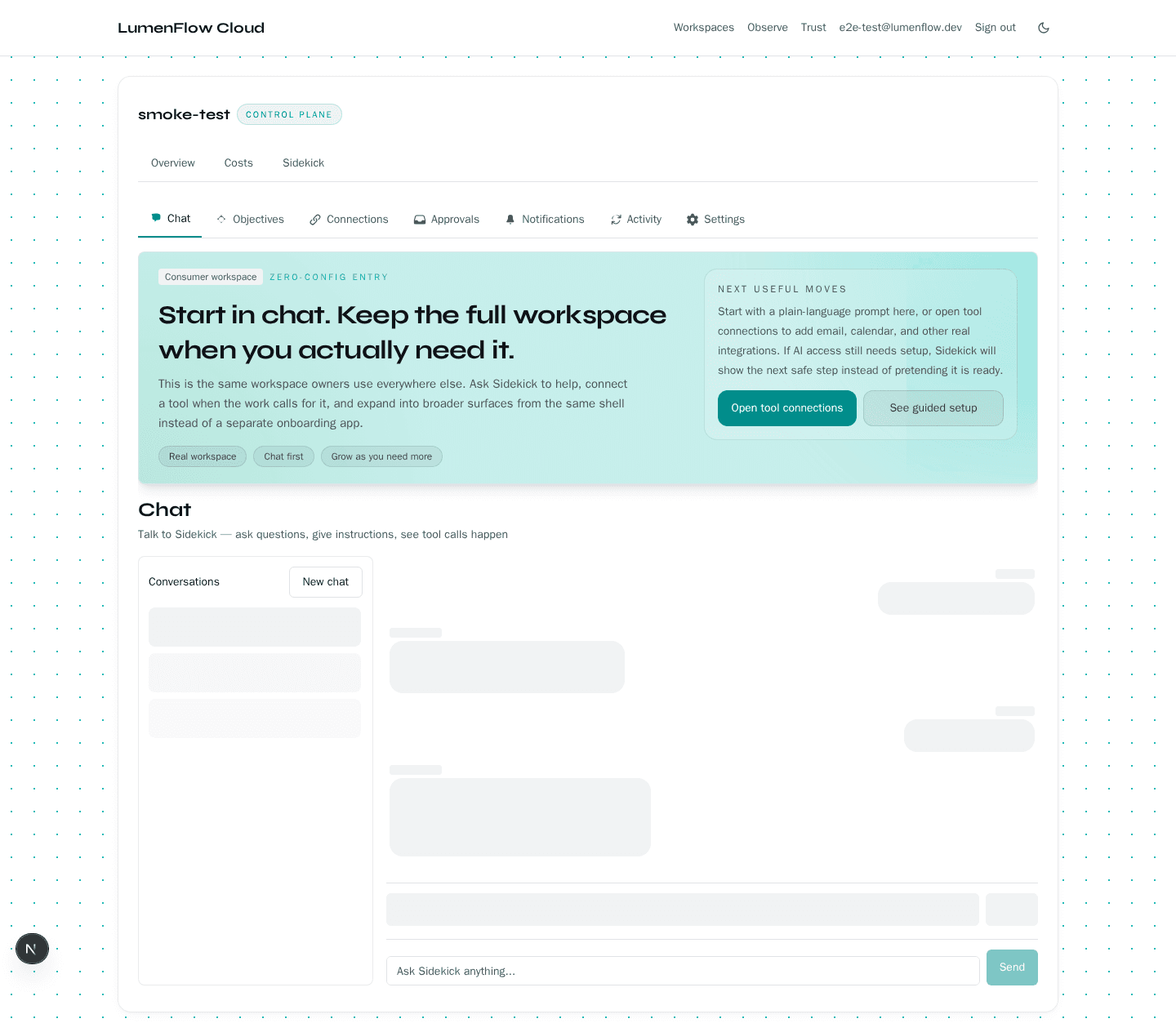
Real Sidekick chat surface with the consumer-first entry and the governed workspace shell.
Captured from the real app in a local seeded workspace
The task completes, but nobody can reconstruct what happened or why it was allowed.
14:02:01
searching flights LAX → JFK
14:02:08
found 3 options, selecting cheapest
14:02:12
accessing payment method ending 4829
14:02:14
booking confirmed — $412.00 charged
14:02:15
calendar event created
14:02:16
done
No approval. No budget check. No receipt.
Policy, approvals, and evidence stay attached to the work all the way through completion.
task/booking scope-boundary verified
budget-gate: $412 within $500 trip limit
payment $412 → owner approval required
@you approved via notification
receipt attached: booking + payment + calendar
Budget checked. You approved. Evidence yours.
Use the same scenario with Sidekick in public.
These public scenarios are real anonymous Sidekick runs in a hosted sandbox environment: sandbox-only sample data, live runtime artifacts, and no external writes. Pick one that matches the motion you are touring right now.
Everything above works locally.
Cloud makes it a team’s system.
LumenFlow Cloud is the hosted layer that distributes policy, manages approvals, and retains evidence for a whole team instead of one machine.
Policy distribution
Publish and inspect the rules that determine what agent work is allowed before risky actions happen.
Approvals and signals
Coordinate operator checkpoints, escalation paths, and workflow steering from one hosted system.
Evidence retention and export
Keep receipts, traces, and audit data long enough to support debugging, compliance, and executive reporting.
Every AI action should be legible.
One workspace. Policy, approvals, and evidence from day one. No credit card required.